March 24, 2025
Mastering Wide-Temperature Chemistry: The Technical Case for Integrating Recirculating Chillers with High-Temperature Oil Baths
Explore how integrated temperature control systems combining chillers and oil baths can dramatically improve research productivity and experimental precision across wide temperature ranges from -80°C to +250°C.
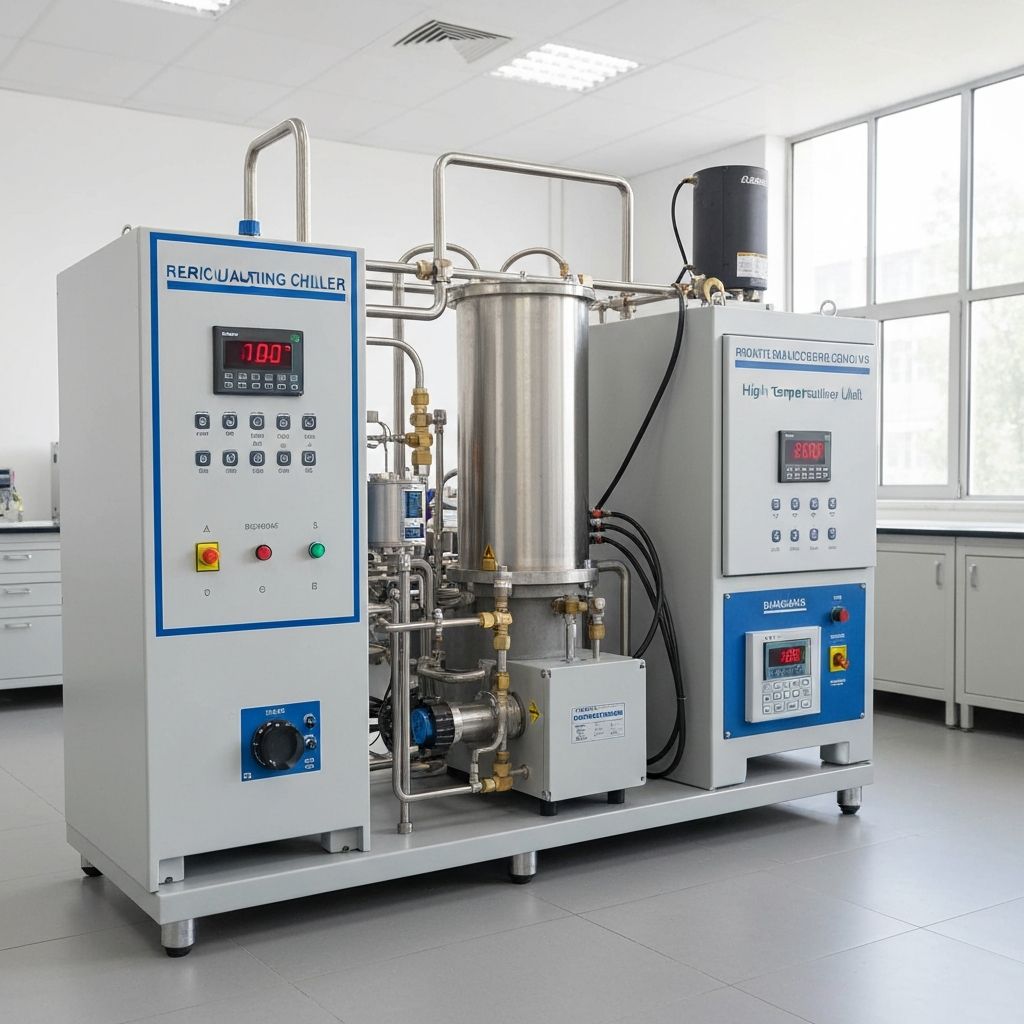
## The Temperature Problem No One Talks About
Let's be honest. Temperature control is the most underappreciated variable in laboratory research. Everyone obsesses over reagent purity, catalyst selection, reaction time. But temperature? That's just a number you set on the dial, right?
**Wrong.**
Here's the reality most chemists and process engineers learn the hard way. The difference between a 92% yield and a 67% yield often comes down to two or three degrees Celsius. The difference between a clean reaction profile and a mess of byproducts? Same story. And when you're working across a wide temperature range — say, from -40°C up to 200°C — the challenge multiplies exponentially.
The global laboratory temperature control units market was valued at roughly **$663 million in 2024**. By 2034, projections suggest it will top **$1.1 billion**, growing at a steady **5.6% CAGR**. Why? Because researchers are finally waking up to what process engineers have known for decades: precise thermal management isn't optional. It's foundational.
Yet many labs still cobble together makeshift solutions. An old chiller that barely holds -20°C. An oil bath that overshoots by 8 degrees before settling. This approach costs time, wastes materials, and generates data you can't fully trust.
> There's a better way. And it starts with understanding why **low temp recirculating chillers** and **high temperature circulating oil baths** work better together than they ever could apart.
---
## Why Standalone Temperature Control Falls Short
Think about what a typical lab setup looks like.
You've got a reactor that needs cooling during exothermic stages, then heating for reflux or distillation. Maybe you're running a crystallization that requires rapid quenching from 80°C down to -10°C. Or you're optimizing a synthetic route that spans sub-ambient conditions all the way up to high-temperature reflux.
With standalone equipment, you're constantly swapping lines, changing fluids, recalibrating setpoints. Every switch introduces variability. Every manual intervention is a chance for error. And when you're pushing the boundaries of **wide temperature range reaction conditions**, those errors compound.
The numbers tell the story. A lab running 15-20 experiments per week across a broad thermal profile might spend **4-6 hours** just managing temperature transitions. That's time not spent analyzing data or designing the next experiment. That's the hidden productivity tax of inadequate **laboratory temperature control systems**.
What makes this especially frustrating? The technology to solve this problem already exists. It just requires a different way of thinking about thermal management — not as two separate tasks, but as one integrated workflow.
---
## Understanding the Two Sides of the Thermal Equation
Before we talk about integration, let's get clear on what each piece of equipment actually does. The terminology gets thrown around loosely, and that creates confusion.
### Low Temp Recirculating Chillers: The Cold Side
A **low temp recirculating chiller** is exactly what it sounds like. It circulates a cooled fluid — typically a water-glycol mixture or specialized thermal fluid — through a closed loop to remove heat from your reactor, condenser, or analytical instrument.
Modern units achieve remarkable stability. Temperature fluctuations of **±0.1°C** are standard on quality systems. Some high-end models maintain **±0.01°C** across their entire operating range.
These chillers serve applications from simple rotary evaporator cooling to complex exothermic reaction control. In pharmaceutical process development, they're essential for maintaining cryogenic conditions during organometallic reactions or keeping bioreactors at precise setpoints during fed-batch fermentation.
The global low-temperature recirculating chiller market reached approximately **$48 million in 2024**, with projections targeting **$80 million by 2031** — a **7.9% CAGR** that reflects growing demand across pharma, chemicals, and materials science.
### High Temperature Circulating Oil Baths: The Hot Side
On the opposite end sits the **high temperature circulating oil bath**. These systems use specialized heat transfer oils — silicone-based or mineral oils — to deliver stable, uniform heating up to **250°C**, sometimes higher.
Unlike simple heating mantles or hot plates, circulating oil baths provide active fluid circulation. This matters enormously. Without circulation, you get hot spots near heating elements and cold zones elsewhere. Your reaction sees a temperature gradient, not a uniform thermal environment.
The circulating oil bath market was valued around **$150 million in 2024** and is expected to reach **$250 million by 2033**, growing at approximately **6.5%** annually. The driving force? Increased demand for precise, reproducible heating in chemical synthesis, materials testing, and pharmaceutical quality control.
Here's what makes oil baths uniquely valuable: thermal stability at high temperatures. Water-based systems top out around 90-95°C. Oil-based systems extend that ceiling dramatically while maintaining excellent temperature uniformity — often **±0.5°C** or better across the bath volume.
---
## What Happens When You Integrate Them
Now let's talk about what happens when you stop treating these as separate pieces of equipment and start viewing them as components of a unified **laboratory temperature control system**.
The integration concept is straightforward. A single reactor jacket or heat exchanger connects to both a recirculating chiller and a high-temperature circulator, with a switching valve or manifold controlling which thermal fluid reaches the reactor at any given moment. More sophisticated systems use a single thermal fluid capable of spanning both temperature extremes — dynamic temperature control systems that can heat and cool without ever changing fluids.
These integrated systems can operate across extraordinary ranges. Some commercial platforms deliver precise control from **-80°C all the way to +250°C** in a single continuous workflow. Others cover -40°C to +200°C, covering the vast majority of synthetic chemistry applications.
The operational benefits cascade through every aspect of your workflow:
- **Continuous temperature ramping** — Need to heat from -20°C to 150°C at 2°C per minute while maintaining ±0.5°C accuracy? An integrated system handles this automatically. No manual intervention, no fluid changes, no lost time.
- **Exothermic management** — Many reactions generate their own heat. An integrated system detects the temperature rise and instantly increases cooling capacity to maintain the setpoint. Standalone equipment simply can't respond this quickly.
- **Reproducibility across runs** — When you eliminate manual switching and fluid changes, you eliminate major sources of run-to-run variability. Data from Monday's experiment compares directly to Friday's. That's how you build robust, scalable processes.
- **Broader experimental space** — With **wide temperature range reaction** capability at your fingertips, you can explore conditions that were previously impractical. Low-temperature lithiation followed by high-temperature cyclization? No problem.
---
## Performance Comparison: Integrated vs. Standalone Systems
Let's look at actual numbers. Here's a side-by-side comparison based on published specifications and real-world application data from **laboratory temperature control equipment** across common performance metrics.
| Metric | Standalone Chiller + Separate Oil Bath | Integrated Wide-Range System | Improvement |
|--------|----------------------------------------|------------------------------|-------------|
| Temperature range without fluid change | -20°C to 40°C (chiller only) / 50°C to 250°C (oil bath only) | -40°C to +200°C (single fluid) | ~4× wider continuous range |
| Temperature stability at extremes | ±0.3°C to ±1.0°C (varies by fluid and load) | ±0.1°C to ±0.3°C (consistent across range) | ~3× better precision |
| Time to switch between hot and cold | 20-45 minutes (fluid drain, change, re-equilibrate) | 0-5 minutes (automated valve switching) | ~10× faster |
| Risk of thermal shock to glassware | High (manual fluid changes, abrupt transitions) | Low (programmable ramp rates, smooth transitions) | Significant safety gain |
| Data continuity across temperature sweep | Poor (multiple equipment changes introduce artifacts) | Excellent (continuous data logging, same system throughout) | Qualitative leap |
| Footprint requirements | 2 separate units + additional bench space for changeover | 1-2 integrated units (often stacked/combined) | 30-40% space savings |
| Daily operator intervention | 3-6 manual adjustments per complex protocol | 0-1 (programmed sequences run unattended) | ~80% reduction |
These differences translate directly into research productivity. A process development team studying a temperature-sensitive crystallization might run 8-10 experiments per week with standalone equipment. The same team with an integrated system? They're running 15-20 experiments in the same timeframe — and each experiment generates higher-quality data.
The economic case is equally compelling. Lab temperature control products overall represent a **$1.5 billion market in 2024**, growing toward **$2.0 billion by 2030**. Within that, the fastest growth is happening in systems that offer versatility — equipment capable of handling both heating and cooling applications without compromising performance at either end.
---
## Real Applications Across Industries
This isn't theoretical. Integrated temperature control is transforming workflows across multiple sectors.
### Pharmaceutical Process Development
When optimizing a synthetic route for an API, chemists need to screen catalysts, solvents, and temperature profiles simultaneously. An integrated wide-range system lets them program a complete thermal profile — cryogenic addition, gradual warm-up, high-temperature reflux, controlled cool-down — as a single unattended run. A pharmaceutical company reported that switching from separate heating and cooling equipment to an integrated **laboratory temperature control system** reduced their process development timeline for a key intermediate by nearly **40%**.
### Biotechnology and Fermentation
Bioreactors for cell culture require precise temperature maintenance, often around 37°C for mammalian cells. But upstream processes like media preparation and downstream steps like product recovery may need both cooling and heating. Integrated systems eliminate the need for multiple dedicated temperature control units, streamlining the entire bioprocess workflow.
### Materials Science and Polymer Research
Polymerization reactions are notoriously exothermic. Without active cooling, temperatures spike and molecular weight distributions go haywire. Integrated systems provide the cooling capacity to manage the exotherm, then seamlessly transition to heating for post-polymerization processing. Researchers studying novel polymeric materials have documented improvements in both yield and product consistency after adopting integrated temperature control.
### Academic and Government Research Facilities
Academic labs face unique constraints — limited space, tight budgets, diverse project portfolios. An integrated system that handles everything from cryogenic reactions to high-temperature synthesis replaces multiple single-purpose instruments, freeing up bench space and capital budget for other priorities.
---
## Market Momentum and the Data Behind It
The numbers confirm what practitioners already know.
The broader laboratory baths market — which includes circulating baths, oil baths, water baths, and related equipment — was estimated at **$13.45 billion in 2024** and is projected to reach **$23.48 billion by 2032**, growing at a healthy **7.1% CAGR**. Within this category, **high temperature circulating oil baths** represent one of the faster-growing segments, driven by expanding applications in chemical synthesis and materials testing.
Meanwhile, the global market for **low temp recirculating chillers** continues expanding at approximately **7.9%** annually through 2031. Demand is particularly strong in pharmaceutical and biotechnology sectors, where temperature-sensitive biologics and complex small-molecule syntheses require precise sub-ambient control.
The **laboratory temperature control systems** market overall — encompassing chillers, circulators, baths, and integrated platforms — is expected to grow from **$639 million in 2025** to **$918 million by 2031**, at a **6.2% CAGR**. Regionally, North America leads with roughly **36-38%** market share, but Asia-Pacific is growing fastest as R&D investment surges across China, India, and Southeast Asia.
What's driving this growth? Three primary forces:
1. **Biologics and complex molecules** — Modern drug candidates are increasingly temperature-sensitive. Monoclonal antibodies, mRNA therapeutics, cell therapies — these modalities demand precision thermal management from discovery through manufacturing.
2. **Process intensification** — Companies are under pressure to compress development timelines. Integrated temperature control enables continuous processing and faster experimental iteration.
3. **Automation and data integrity** — Modern systems log every temperature data point, creating auditable records essential for regulatory submissions. This data also feeds AI/ML models for predictive process optimization.
---
## What to Look for in a Laboratory Equipment Manufacturer
Not all **laboratory equipment manufacturers** approach temperature control the same way. When evaluating options for your lab, here are the factors that separate the genuinely capable from the merely adequate.
### Temperature Range and Fluid Compatibility
The best systems cover -40°C to +200°C with a single thermal fluid. That eliminates changeover time and reduces contamination risk. Ask for documented performance across the full range, not just at ambient conditions.
### Heating and Cooling Capacity
Rated capacity (in kW for heating, BTU/hr or kW for cooling) tells you whether the system can actually handle your reactor volume and thermal load. Undersized equipment leads to slow ramps, poor temperature control, and frustrated chemists.
### Control Precision and Stability
Look for PID control with at least **±0.1°C** stability under load. Higher-end systems offer **±0.01°C** — essential for crystallization studies and other temperature-sensitive applications.
### Automation and Software Integration
Can the system be programmed for complex thermal profiles? Does it support remote monitoring and data export? Integration with LIMS and electronic lab notebooks is increasingly standard expectation.
### Safety Features
Over-temperature protection, low fluid level detection, pressure relief — these are not optional. High-temperature oil baths pose fire risks if fluid degrades or overheats. Properly engineered systems include multiple redundant safety systems.
### Support and Service
Temperature control equipment requires periodic maintenance. Compressors need service. Thermal fluids degrade. Choose a manufacturer with responsive technical support and clear service documentation.
The good news: established **laboratory equipment manufacturers** offer systems spanning a range of capabilities and price points. The key is matching specifications to your actual workflow requirements — not overbuying capabilities you'll never use, and certainly not underbuying and struggling with inadequate performance.
---
## The Bottom Line
Temperature control shouldn't be the limiting factor in your research.
When **low temp recirculating chillers** and **high temperature circulating oil baths** are paired thoughtfully — as components of a unified **laboratory temperature control system** — they enable **wide temperature range reaction** capabilities that simply aren't achievable with standalone equipment.
The data supports this. Integrated systems deliver better temperature stability, faster thermal transitions, higher experimental throughput, and more reproducible results. The market is responding accordingly, with steady growth projected across all segments of laboratory temperature control equipment.
For lab managers and research directors, the question isn't whether to upgrade temperature control infrastructure. It's when, and with which configuration. The productivity gap between labs with integrated thermal management and those still relying on piecemeal solutions will only widen as experimental complexity continues to increase.
> A well-designed **laboratory temperature control system** isn't just another piece of equipment. It's a force multiplier for your entire research operation. Choose carefully, and it will serve as the thermal foundation for years of productive science.