March 31, 2025
Mastering the Synergy of Vacuum, Temperature, and Rotation for Superior Solvent Recovery
Optimize your rotary evaporator performance by understanding the interplay between vacuum, temperature, and rotation speed. Learn the Delta 20 principle and practical techniques for efficient, gentle solvent removal.
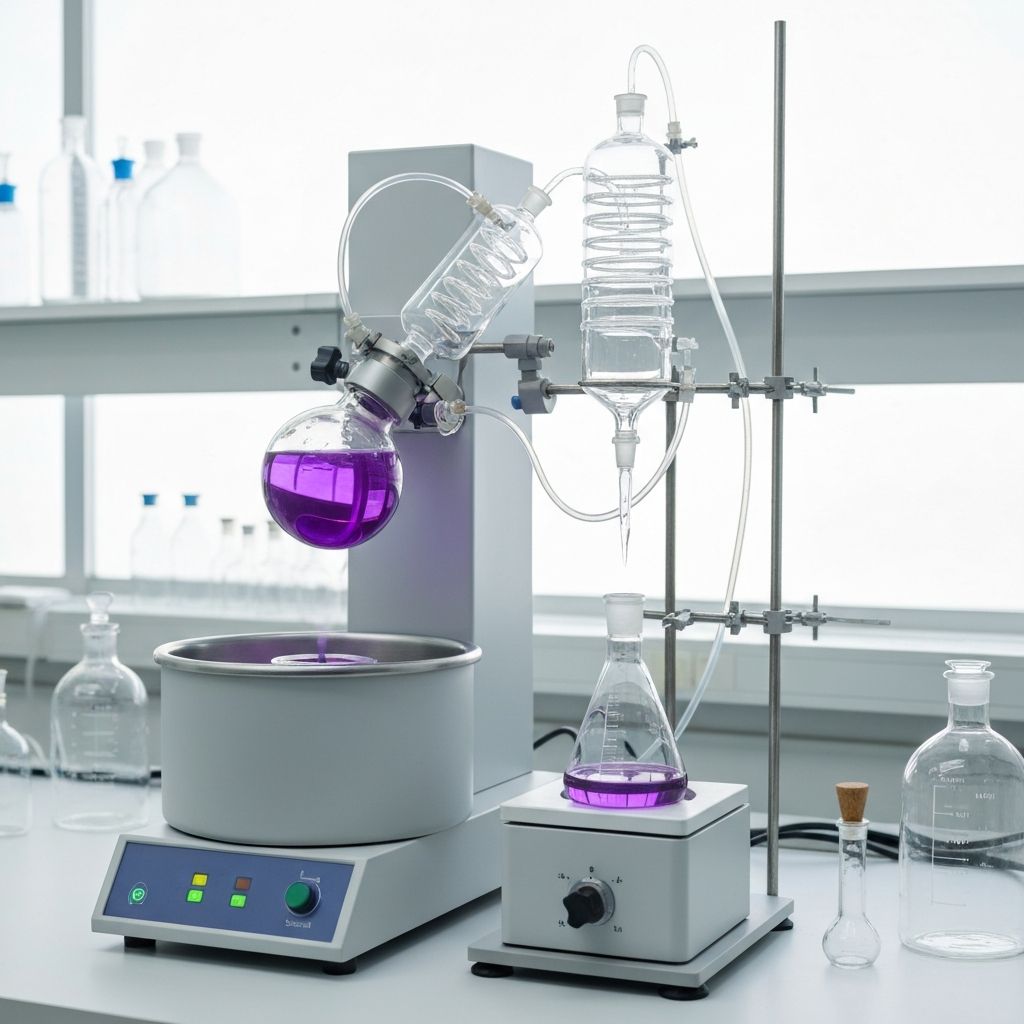
When it comes to solvent removal in modern laboratories, few tools are as ubiquitous or as essential as the rotary evaporator. However, simply owning a high-quality **laboratory evaporator** is not a guarantee of excellent results. The real magic lies in understanding and optimizing the relationship between three critical parameters: **vacuum**, **temperature**, and **rotation speed**.
A recent study published in the Bulletin of Environmental Contamination and Toxicology highlighted the profound impact of precise parameter control. By modifying the water bath temperature control system alone, researchers were able to boost the recovery rate of phthalate esters from **72.4% to a remarkable 93.2%–98.5%**. This serves as a powerful demonstration: getting these variables right is not just a matter of incremental improvement — it can be a game-changer for laboratory productivity and sustainability.
> This article will walk you through the science behind these three pillars, explaining how they interact and how you can leverage that synergy for optimal performance in your own work.
---
## The Three Pillars of Efficient Rotary Evaporation
The fundamental principle of vacuum rotary evaporation is relatively straightforward, yet its nuances are profound. As described by modern white papers on the subject, a contemporary **rotary evaporator** functions as a highly precise thermodynamic distillation system. Within it, temperature, pressure, and rotational speed are electronically controlled and continuously adjusted based on the solvent, sample volume, and viscosity.
The process begins by placing your solution in a rotating flask, which is partially submerged in a heated bath. The rotation creates a thin, continuous liquid film along the flask's inner wall, maximizing the surface area for heat transfer and evaporation. Simultaneously, the application of vacuum lowers the system pressure, thereby reducing the boiling point of the solvent according to its vapor pressure curve. This allows for gentle, low-temperature evaporation, which is essential for preserving the integrity of heat-sensitive compounds.
Getting this process to peak efficiency requires a fine-tuned, synergistic approach. Let's break down each component.
---
## Vacuum: The Cornerstone of Gentle Solvent Removal
### How Reduced Pressure Works
Vacuum is arguably the most powerful tool in the rotary evaporator's arsenal. By lowering the pressure inside the system, you effectively lower the boiling point of the solvent. This is what makes it possible to remove high-boiling solvents, like DMSO or DMF, at temperatures far below their standard atmospheric boiling points.
A study on optimizing high-boiling solvent removal found that a deep vacuum, specifically **below 40 mbar**, is often necessary for efficient evaporation. The type of vacuum pump you choose plays a significant role here:
- **Diaphragm Pumps** — These are the gold standard for most labs. They offer excellent chemical resistance and are oil-free, making them virtually maintenance-free and perfect for routine solvent removal.
- **Rotary Vane Pumps** — These provide a deeper vacuum but require regular oil changes and are not suitable for corrosive solvents, which can damage the pump internals.
- **Water Aspirators** — While inexpensive, these offer lower and inconsistent vacuum levels and waste a significant amount of water, making them less favored in modern, sustainable labs.
### Matching Vacuum to Solvent Type
The vacuum level is not a one-size-fits-all setting. It should be carefully selected based on the specific solvent you are working with:
- **Low-boiling solvents** (e.g., acetone, dichloromethane, diethyl ether) — These require a relatively modest vacuum to prevent the solvent from "bumping" or boiling so vigorously that it carries over into the condenser or receiver. An efficient condenser with a chilled coolant is critical here.
- **High-boiling solvents** (e.g., water, DMF, DMSO) — These demand a deep vacuum and a higher bath temperature to drive evaporation at a reasonable rate. The goal is to pull the strongest vacuum your system can reliably maintain.
---
## Temperature: The Delta 20 Principle in Practice
### Heating Bath Optimization
While vacuum lowers the required energy, the heating bath provides it. The key to efficient and gentle evaporation is to supply just enough heat without causing thermal degradation of your sample. A widely accepted guideline for setting bath temperature is the **Delta 20 rule**.
> This principle states that for efficient evaporation, the heating bath temperature should be approximately **20°C higher** than the boiling point of the solvent, and the cooling temperature should be at least **20°C lower** than the solvent's boiling point.
For example, if you are evaporating ethanol at a specific vacuum where its boiling point is 30°C, you would set your heating bath to around **50°C** and your chiller to **10°C or lower**. This 20°C temperature differential on both sides of the vaporization process ensures a robust energy flow without overheating the sample.
### Cooling and Condensation Efficiency
The other half of the temperature equation is cooling. Efficient condensation is just as important as efficient evaporation for high solvent recovery. If your condenser cannot keep up, solvent vapors will simply be pulled through the system and lost into the vacuum pump — a serious issue for both sustainability and pump longevity.
- **Tap Water Cooling** — This is simple but limited, typically achieving temperatures of only 15-25°C, which is insufficient for very volatile solvents.
- **Recirculating Chillers** — These offer precise and powerful cooling, often down to -10°C, -20°C, or even lower. For low-boiling solvents or high-throughput applications, a recirculating chiller is not a luxury — it's a necessity. Using a chiller can boost condensation efficiency by up to **40%** compared to tap water.
---
## Rotation Speed: Creating the Perfect Thin Film
### Viscosity and Speed Selection
The rotation of the evaporation flask is what sets this technique apart from simple distillation. As the flask spins, it creates a thin film of solution on the heated inner wall. This dramatically increases the surface area for evaporation and prevents localized overheating.
The optimal rotation speed is highly dependent on the viscosity of your sample. A general guideline is to aim for **100-200 RPM** for most common applications. Here's a more detailed breakdown:
- **Low Viscosity** (e.g., ethanol, acetone) — Higher speeds (150-300 RPM) are ideal to maximize the surface area of the thin film, accelerating evaporation.
- **High Viscosity** (e.g., polymers, crude extracts) — Slower speeds (50-150 RPM) are better. Too high a speed with a viscous sample can lead to cavitation and splashing, not efficient evaporation.
### Preventing Bumping and Foaming
One of the key benefits of proper rotation is its ability to prevent "bumping" — the sudden, violent boiling that can eject your sample from the flask and into the condenser. The constant rotation ensures uniform heat distribution and mixing within the flask, creating a stable evaporation process.
---
## The Interplay of the Three Parameters
Optimizing a **rotary evaporator** is not about setting each parameter in isolation; it's about understanding how they work together. Think of them as three interlocking gears:
- **Vacuum and Temperature** — The vacuum sets the stage by lowering the boiling point, and the heating bath provides the energy. If you increase the vacuum (lower the boiling point), you can and should lower the bath temperature to protect sensitive compounds.
- **Temperature and Rotation** — The heating bath provides energy, and rotation ensures this energy is distributed evenly across the largest possible surface area. If you increase the bath temperature, you may need to increase rotation speed to prevent localized hot spots.
- **Rotation and Vacuum** — Rotation creates the thin film that allows for rapid vaporization. The vacuum then pulls these vapors away from the film. A slower rotation may be necessary with a very deep vacuum to prevent the solution from boiling too vigorously.
> When these three parameters are optimally coordinated, evaporation proceeds efficiently, gently, and reproducibly. Real-world results bear this out: in one case study, optimizing all three parameters for an antibiotic extraction increased evaporation efficiency by a factor of **four**, cut the degradation of active ingredients from **15% to just 2%**, and boosted solvent recovery from **70% to a stellar 95%**.
---
## Practical Guidance for Rotary Evaporator Selection
Choosing the right equipment from the myriad of options available from any **laboratory equipment manufacturer** can be daunting. Here are key factors to consider to ensure your rotary evaporator selection aligns with your laboratory's specific needs.
### Capacity and Application Matching
Start by defining your typical application and scale. **Laboratory evaporator** models are available in a wide range of sizes, generally categorized by evaporation flask volume:
- **1L to 5L** — Ideal for research and development, academic settings, and routine analytical work.
- **10L to 20L** — Suited for pilot-scale work and medium-throughput batch processing.
- **20L and above** — Required for industrial and production-scale applications.
A good rule of thumb is to fill your evaporation flask to only **50-70%** of its maximum capacity to prevent splashing and bumping during operation.
### Key Technical Specifications
Beyond capacity, pay close attention to these core specifications when evaluating **solvent recovery equipment**:
- **Vacuum Pump Compatibility** — Ensure the pump is appropriate for your solvents. Diaphragm pumps are the best all-around choice for a chemical lab.
- **Condenser Type and Cooling** — For low-boiling solvents, a high-efficiency condenser (such as a double-coil design) paired with a recirculating chiller is essential.
- **Rotation Speed Range** — Look for a unit with a wide, variable speed range (e.g., 20-300 RPM) to accommodate both low-viscosity and high-viscosity samples.
- **Temperature Control Accuracy** — Precise digital control with an accuracy of ±1°C or better is standard on modern, high-quality units and is crucial for reproducible results.
---
## Conclusion: A Holistic Approach to Solvent Recovery Equipment
The path to high-efficiency solvent recovery is not a secret; it is a science. It requires moving beyond simply operating a piece of equipment and toward understanding the fundamental thermodynamic principles at play. By viewing your **rotary evaporator** as an integrated system and carefully balancing vacuum, temperature, and rotation speed, you can dramatically improve not only the speed of your work but also its quality and environmental footprint.
This approach is increasingly important as the global market for laboratory rotary evaporators continues to grow, reaching an estimated value of **US$188 million in 2025**. As labs worldwide focus on sustainability and efficiency, the ability to maximize solvent recovery is both an economic and an environmental imperative. With a thoughtful approach to both rotary evaporator selection and operation, any lab can achieve superior performance and more sustainable outcomes.