April 7, 2025
Glass vs. Stainless Steel Reactors: How to Match Vessel Material to Your Chemical Process
A comprehensive guide to selecting the right reactor material. Understand chemical compatibility, pressure and temperature limits, cost considerations, and application-specific recommendations for glass, stainless steel, and glass-lined reactors.
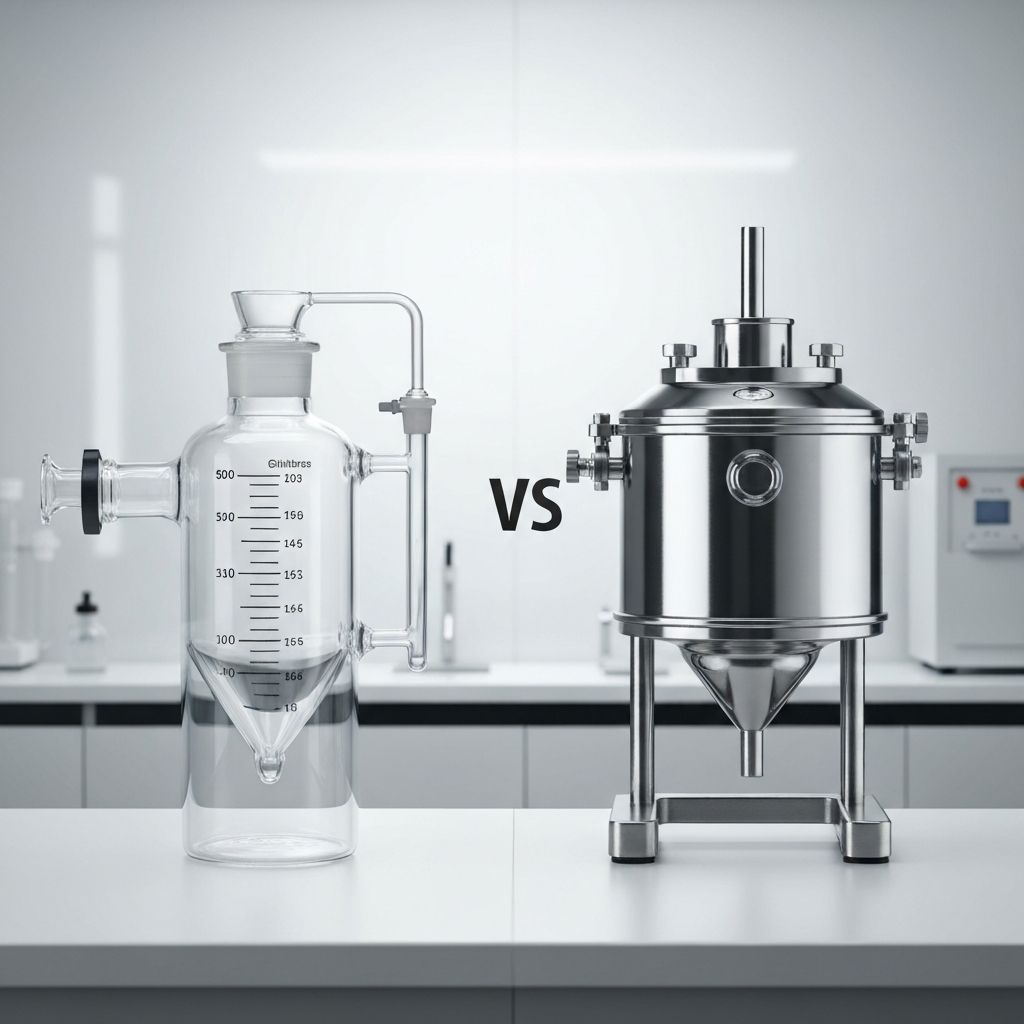
## Why Reactor Material Choice Defines Your Experiment's Success
Here's a conversation that happens in research labs more often than anyone admits.
A chemist needs to run a series of reactions. They look at the equipment catalog, see a **glass reactor** and a **stainless steel reactor** side by side, and pick one based on what's available or what their colleague used. The reaction goes fine — or it doesn't. Maybe the glass vessel cracks under thermal shock. Maybe the stainless steel leaches trace metals into a sensitive pharmaceutical intermediate. Either way, the experiment is compromised.
The choice between glass and stainless steel isn't about which material is "better." It's about which material matches your chemistry.
**Laboratory reactor selection** fundamentally starts with understanding what you're putting into the vessel and what conditions you need to create. The primary consideration in choosing a reactor material is its chemical compatibility with the reactants and products involved in the process — different materials have varying degrees of resistance to corrosion, and some may even react with certain chemicals, leading to contamination or structural degradation.
Glass and stainless steel represent two fundamentally different approaches to solving the same engineering challenge: containing a chemical reaction safely while allowing heat transfer, mixing, and — ideally — observation. Glass prioritizes visibility and chemical inertness. Stainless steel prioritizes mechanical strength and thermal durability.
---
## Market Snapshot — Both Materials Are Growing, For Different Reasons
The global market data confirms that both materials have strong, sustained demand — but for distinctly different applications.
The global **glass reactor** market was estimated at **USD 852.75 million in 2024** and is projected to reach **USD 1,496.40 million by 2032**, growing at a CAGR of **7.56%** during the forecast period. Within this broader category, the glass-lined reactor segment was valued at approximately **USD 1,317 million in 2025** and is expected to reach **USD 1,888 million by 2032** at a **5.4% CAGR**. Double glass reactors specifically are projected to grow even faster, from **USD 245.26 million in 2025** to **USD 485.29 million by 2032** at a **10.24% CAGR**.
On the stainless steel side, the global market was valued at approximately **USD 2,117 million in 2024** and is forecast to reach **USD 3,061 million by 2031**, growing at a **5.5% CAGR**. Market analysis shows that over **15,000 industrial reactor systems** are installed globally, with approximately **65%** used in chemical processing industries. Notably, about **58%** of stainless steel reactors are deployed in high-pressure, high-temperature applications.
> What these numbers reveal is straightforward: glass reactor demand is driven by pharmaceutical R&D and fine chemical synthesis where purity matters. Stainless steel demand is driven by industrial production, petrochemicals, and processes requiring high pressure or temperature extremes.
---
## Understanding Glass Reactors — Transparency Meets Chemical Inertness
**Glass reactors** — typically fabricated from borosilicate glass 3.3 (G3.3) — are designed around a core principle: what you can't see, you can't control. The transparency of glass enables real-time visual monitoring of reaction progress, phase separation, crystallization, and color changes that no amount of instrumentation can fully replace.
### What Makes Borosilicate Glass 3.3 Special
Borosilicate glass 3.3 is an engineered material with a specific composition: approximately **78–80% silica** and **12.5–13.5% boron oxide**, with sodium oxide making up the balance. This composition yields a linear thermal expansion coefficient of **(3.3 ± 0.1) × 10⁻⁶/K** — extremely low compared to ordinary soda-lime glass.
The thermal capabilities are impressive for a transparent material. Borosilicate glass can operate continuously at **450°C**, with some specially treated grades reaching **550°C**, and can withstand instantaneous temperature spikes up to **650°C** under controlled conditions.
### Chemical Resistance Profile
Borosilicate glass 3.3 is resistant to chemical attack by almost any product. It is highly resistant to:
- Deionized water and saline solutions
- Organic substances
- Halogens such as chlorine and bromine
- Most acids
There are only a few chemicals that can cause noticeable corrosion: **hydrofluoric acid**, **concentrated phosphoric acid**, and **strong caustic solutions at elevated temperatures**. However, at ambient temperatures, caustic solutions up to 30% concentration can be handled without difficulty.
### The Transparency Advantage
This is the feature that no metal reactor can match. A researcher can watch crystallization occur in real time. They can see when a color change signals reaction completion. They can identify phase separation, precipitation, or unexpected side reactions immediately — rather than discovering them hours later during workup.
### The Limitations
Glass reactors typically operate at atmospheric or low positive pressure — up to **0.1 MPa**, though specialized designs can reach **6–12 bar**. Temperature ranges are typically **–80°C to +200°C** with proper thermal fluid circulation.
---
## Understanding Stainless Steel Reactors — Industrial Durability Under Pressure
**Stainless steel reactors** — commonly fabricated from 304, 316, or 316L alloys — represent the industrial workhorse of chemical processing.
### Material Grades and What They Mean
The most common grade for laboratory and pilot-scale applications is **316L stainless steel**. The "L" designation indicates low carbon content, which improves weldability and reduces the risk of intergranular corrosion after welding.
For more aggressive environments, higher-performance alloys come into play:
- **Hastelloy C-276** — excellent resistance to chlorides and acids
- **Titanium** — outstanding resistance to oxidizing agents and chloride stress corrosion
### Mechanical and Thermal Strengths
These reactors can withstand **pressures up to 10 MPa or higher**. Operating temperatures range from **–20°C to +300°C** for standard designs, with some configurations reaching **400°C** or above.
Thermal conductivity is another key differentiator. Stainless steel conducts heat at approximately **16 W/m·K**, while borosilicate glass manages only about **1.1 W/m·K**. This means stainless steel reactors heat and cool faster — a critical advantage for exothermic reactions.
### Corrosion Limitations
While 316 stainless steel offers excellent corrosion resistance in many environments, it is not resistant to everything:
- Concentrated hydrochloric acid
- Hot sulfuric acid
- Chloride-containing solutions at elevated temperatures
For highly corrosive media, **glass-lined steel reactors** are often preferred.
---
## Head-to-Head Comparison — What the Data Shows
| Property | Glass Reactors (Borosilicate 3.3) | Stainless Steel Reactors (316L) |
|----------|-----------------------------------|--------------------------------|
| Chemical Resistance | Excellent for acids and organics; avoid HF and hot alkalis | Moderate; avoid strong acids and chlorides |
| Pressure Rating | ≤ 0.1 MPa (up to 6–12 bar specialized) | Up to 10 MPa or higher |
| Temperature Range | –80°C to +200°C (glass itself to 450°C) | –20°C to +300°C (up to 400°C special) |
| Thermal Conductivity | ~1.1 W/m·K | ~16 W/m·K |
| Transparency | Full visual monitoring | Opaque (requires sight glasses) |
| Mechanical Strength | Brittle; vulnerable to impact | High; excellent impact resistance |
| Scalability | Limited to lab/pilot scale (≤100L) | Lab to full industrial production |
| Initial Cost (Lab Scale) | Lower for small volumes | Higher, especially corrosion-resistant grades |
| Maintenance | Easy cleaning; cannot be repaired | Can be welded and repaired |
| Contamination Risk | Near-zero (inert surface) | Potential for trace metal leaching |
---
## Chemical Compatibility — The First Decision Point
Before considering temperature, pressure, or cost, start with this question: **What chemicals are going into this vessel?**
### When to Choose Glass
Glass reactors are the clear choice when working with:
- **Strong mineral acids** — hydrochloric acid, sulfuric acid (moderate concentrations), nitric acid
- **Halogenated solvents and halogens** — chlorine, bromine, chloroform, DCM
- **Organic solvents** — virtually all common organic solvents are compatible
- **Sensitive pharmaceutical intermediates** — where trace metal contamination would ruin a batch
### When to Choose Stainless Steel
Stainless steel reactors are better suited for:
- **Alkaline conditions** — caustic solutions at elevated temperatures attack glass
- **Neutral aqueous systems** — where corrosion risk is minimal
- **Hydrocarbons and petrochemicals** — stainless steel offers excellent resistance
- **Fermentation and biochemical processes** — where sanitization and mechanical durability matter
### The Hybrid Option — Glass-Lined Steel
For processes requiring both the corrosion resistance of glass and the pressure tolerance of steel, **glass-lined reactors** offer a compelling middle ground. These vessels combine the inside glass coating with the outside steel structure, with the glass coating fused onto the steel surface at high temperature. They represent about **40%** of the glass-lined reactor market.
---
## Temperature and Pressure — Where the Real Limits Lie
### Pressure Requirements
Glass reactors are fundamentally atmospheric or low-pressure vessels. Standard configurations operate from full vacuum up to approximately **0.1 MPa** positive pressure. For moderate pressure applications — up to **6–12 bar** — specialized high-pressure glass autoclaves are available.
Stainless steel reactors are engineered for pressure. Standard designs handle pressures up to **10 MPa** routinely, with specialized vessels reaching **30 MPa or higher**. This makes stainless steel the only viable choice for hydrogenation, supercritical fluid research, and any process involving gases at elevated pressures.
### Temperature Requirements
Glass reactor systems typically operate from **–80°C to +200°C** with jacketed thermal fluid systems. Stainless steel reactors offer **–20°C to +300°C** for standard configurations, with high-temperature designs reaching **400°C or above**.
---
## Cost, Maintenance, and Long-Term Value
### Initial Investment
For laboratory-scale applications, glass reactors generally have a lower initial purchase price than equivalent stainless steel reactors. Stainless steel reactors range widely in cost depending on material grade — **Hastelloy or titanium** reactors can cost **3–5 times more** than comparable stainless steel units.
### Maintenance and Repair
Glass reactors offer easy cleaning — the non-stick surface means residues rarely adhere. However, if a glass vessel cracks or chips, it cannot be repaired. Replacement is the only option.
Stainless steel reactors can be welded, polished, and adapted on-site. This repairability makes stainless steel more economical over long service lives in industrial environments.
---
## Application-by-Application Selection Guide
### Pharmaceutical R&D and API Synthesis
**Choose glass.** The ability to visually monitor crystallization, the absolute chemical inertness to prevent metal contamination, and the ease of cleaning between batches make glass reactors the standard. The pharmaceutical sector represents about **47.3%** of glass reactor demand.
### Catalytic Hydrogenation
**Choose stainless steel.** Hydrogenation requires pressures of **1–10 MPa** and often elevated temperatures. Glass cannot safely contain these conditions.
### Polymerization
**Choose stainless steel** for most applications. Polymerization often involves viscous media requiring robust stirring and exothermic temperature control requiring fast heat transfer.
### Acid Digestion and Strong Acid Processing
**Choose glass or glass-lined steel.** Strong mineral acids will rapidly corrode stainless steel.
### Educational Laboratories
**Choose glass.** The transparency allows students to see what's happening — color changes, phase separation, precipitation — making abstract chemistry concepts tangible.
### Pilot Plant and Scale-Up
**Choose stainless steel or glass-lined steel.** At pilot scale (50–500L), pure glass vessels become impractical.
### Biotechnology and Fermentation
**Choose stainless steel.** Sanitary design, steam sterilizability, and CIP protocols make stainless steel the standard. About **55%** of pharmaceutical companies rely on stainless steel reactors for drug manufacturing.
---
## What to Look For in a Laboratory Equipment Manufacturer
### Material Certifications and Traceability
For stainless steel vessels, request material test reports (MTRs) confirming the alloy grade. For glass reactors, borosilicate 3.3 should meet ISO 3585 specifications.
### Pressure Testing and Documentation
Any vessel intended for pressure service should come with hydrostatic test certification at **1.3–1.5× the maximum allowable working pressure**.
### Customization Capability
A quality manufacturer can customize port configurations, stirring systems, heating/cooling jackets, and instrumentation interfaces.
### After-Sale Support
Spare parts availability — seals, gaskets, O-rings, replacement glass components — matters enormously. A reactor that sits idle waiting for a simple seal is wasted capital.
### Industry-Specific Compliance
For pharmaceutical applications, look for cGMP-compliant design features. For pressure vessel service in regulated jurisdictions, verify ASME or PED certification.
The right **laboratory equipment manufacturer** becomes a partner in your research or production capability — helping you select not just a reactor, but the right reactor for what you're actually trying to accomplish.