April 21, 2025
Accelerating Drug Discovery Timelines: A Deep Dive into High-Throughput Parallel Reactor Technology
Discover how parallel reactor systems are revolutionizing pharmaceutical R&D by transforming months of sequential experimentation into days of parallel optimization. Learn why Eroom's Law demands a new approach.
## The Productivity Paradox in Modern Pharmaceutical R&D
Let's be honest about something. The pharmaceutical industry has a productivity problem that nobody likes to talk about at conferences.
For decades now, the cost of bringing a new drug to market has been climbing relentlessly — doubling roughly every nine years. This phenomenon, which researcher Jack Scannell famously dubbed **"Eroom's Law"** (Moore's Law spelled backwards), is a sobering reality that R&D leaders wrestle with daily. Back in the 1950s, developing a drug was expensive but manageable. Today? The fully capitalized cost per approved drug sits somewhere between **$1.3 billion and $2.6 billion**. Some analyses that factor in the full portfolio of failed projects put that number even higher — around **$5.5 billion**.
That's not sustainable. Something's got to give.
The root cause isn't that scientists are less talented than they used to be. Far from it. The problem is the sheer complexity of modern drug targets, combined with workflows that — until recently — haven't fundamentally changed in decades. Traditional sequential experimentation, where you run one reaction, analyze it, tweak a variable, and run another... it's like trying to map a continent by walking it on foot. You'll get there eventually, but your competitors might have already built a highway.
This is exactly where **parallel reactor systems** and **high throughput reactor** technologies enter the conversation. Not as a nice-to-have upgrade. As a necessity.
---
## What Exactly Is a Parallel Reactor System?
Before we go deeper, let's get our definitions straight.
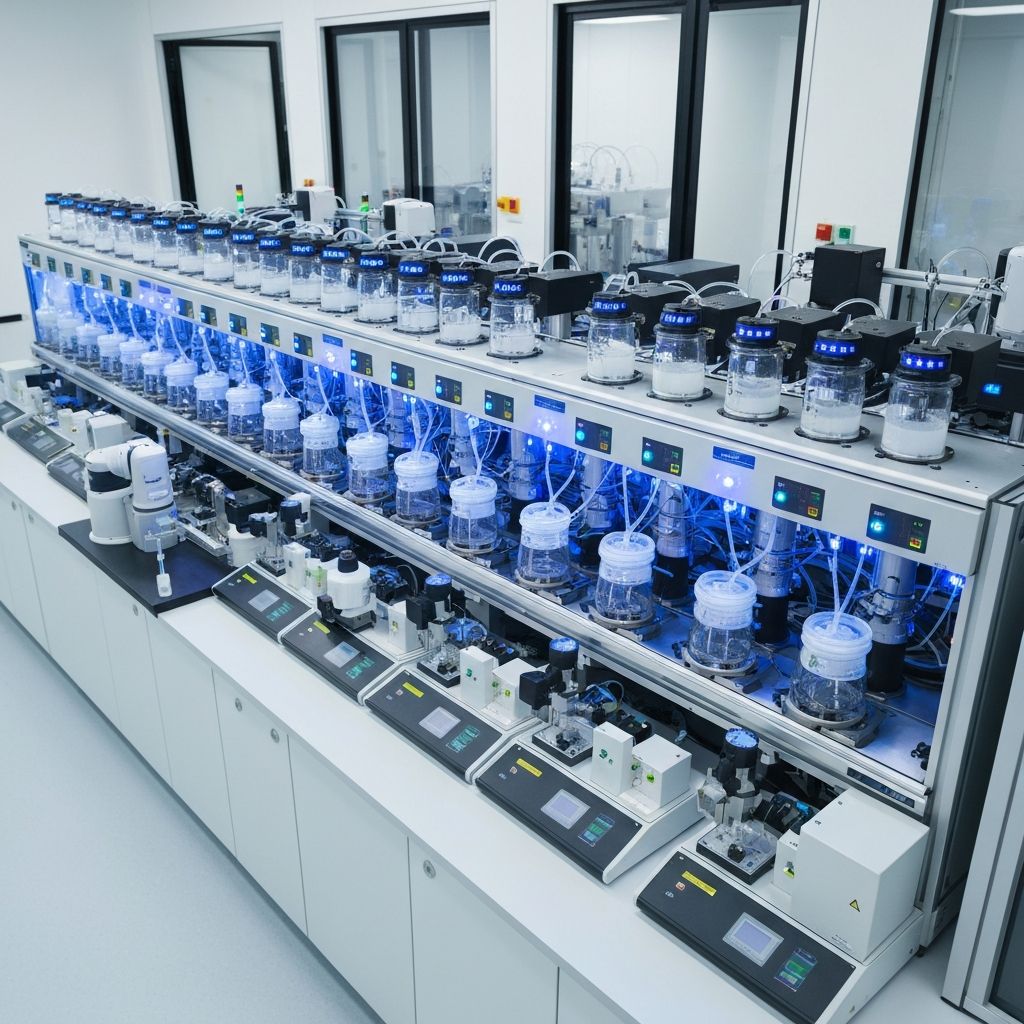
A **parallel reactor system** is a specialized piece of laboratory equipment designed to run multiple chemical or biological reactions simultaneously under precisely controlled and independent conditions. Think of it this way: instead of one reaction vessel on a stir plate, you might have 4, 8, 16, or even 48 individual reactors all operating at the same time. Each reactor can have its own temperature profile, pressure setting, stirring speed, and reagent composition.
These systems come in various configurations depending on what you're trying to accomplish:
- **Parallel bioreactor systems** are the go-to choice for biopharmaceutical work — cell culture optimization, fermentation studies, monoclonal antibody production. They let researchers run multiple fed-batch experiments concurrently, tracking parameters like dissolved oxygen, pH, and metabolite concentrations in real time.
- For synthetic chemistry applications, **parallel reaction stations** offer capabilities like high-pressure hydrogenation screening, catalyst evaluation, and multi-variable reaction optimization. The more sophisticated systems integrate automation for liquid handling, sampling, and even direct-to-analysis workflows that feed samples into LC/MS or HPLC instruments without human intervention.
What makes these tools genuinely transformative is not just that they run multiple experiments at once. It's that they generate **comparable data** across all parallel runs. Every reactor vessel shares the same environmental control framework, which eliminates the batch-to-batch variability that plagues traditional sequential workflows.
---
## How Parallel Reactors Transform Drug Screening Workflows
Drug discovery, at its core, is a numbers game.
You're screening thousands — sometimes millions — of compounds against a biological target, hoping to find a handful of hits worth pursuing. In the old days, this was painfully manual work. Today, high throughput screening (HTS) has matured into a cornerstone of contemporary drug discovery, with the global HTS market valued at approximately **$22.32 billion in 2025** and projected to reach **$33.44 billion by 2032**.
But here's the nuance that often gets lost: HTS is not just about the screening instrumentation. The upstream chemistry — synthesizing the compound libraries, optimizing the synthetic routes, validating the reaction conditions — has historically been a bottleneck. You can't screen compounds that haven't been made yet.
**Parallel reactors solve this by accelerating the synthesis and optimization phase.** A well-designed parallel reactor platform lets a discovery chemist explore a broad chemical space in days rather than weeks. Want to test 8 different catalysts with 2 different solvents across a temperature gradient? A 16-position parallel reactor can handle that in a single run.
And it gets better. Modern drug screening equipment often integrates parallel reactors with robotic liquid handlers and automated analytical instruments. A case study from Roche Pharma Research illustrates this beautifully: they integrated parallel microbioreactors with a Tecan Fluent robotics system and a Cedex BioHT Analyzer, all orchestrated through middleware that manages data flow between instruments. The result? They doubled the number of projects in process development without significantly increasing headcount.
That's the kind of efficiency gain that makes CFOs smile.
---
## Process Optimization: From Months to Days
If drug discovery is about finding hits, process optimization is about making those hits manufacturable. This is where the rubber meets the road — and where parallel reactors deliver some of their most dramatic time savings.
Let me give you a concrete example. A standard 16-position parallel reactor system was used to optimize the synthesis of an anti-diabetic drug candidate. The goal: identify the ideal combination of catalyst, solvent, temperature, and reaction time. Traditional sequential optimization for something like this typically takes **3 months** of trial and error — sometimes more. With the parallel system? They locked in the optimal conditions in just **72 hours**.
> **Three days versus three months. That's not an incremental improvement. That's a step-change.**
Another compelling example comes from high-pressure catalysis work. A 48-cell parallel pressure reactor was deployed to optimize a palladium-catalyzed reaction for synthesizing 2-substituted indoles. The traditional approach would have tied up a full-time chemist for an estimated 3 to 6 months. The parallel reactor screening took about a week to 10 days. Even better, the optimization dropped catalyst loading from 5-10 mol% down to 0.1%, reduced pressure from 400-500 psi to 15 psi, and lowered temperature from 120°C to 70°C — all while improving yield.
Those aren't just faster results. Those are **better results**. The economic implications — reduced catalyst costs, milder operating conditions, less energy consumption — add up quickly when you scale to manufacturing.
In bioprocessing, process optimization reactors in parallel configurations are equally transformative. A study published in 2025 demonstrated how parallel bioreactors could rapidly map the relationship between growth rate and product yield for mevalonate production. By running multiple fed-batch experiments in parallel, researchers quickly identified the optimal growth rate of 0.34 h⁻¹ that maximized yield while minimizing unwanted acetate formation. This kind of multi-variable optimization used to take months; now it happens in days.
---
## Data Comparison: Parallel vs. Traditional Approaches
Numbers tell the story better than adjectives ever could. Here's a side-by-side look at what parallel reactor systems deliver compared to conventional sequential workflows:
| Metric | Traditional Sequential | Parallel Reactor System | Improvement Factor |
|--------|------------------------|------------------------|-------------------|
| Reaction optimization timeline (catalyst screening) | 3-6 months | 7-10 days | ~10-20× faster |
| Experiments per week (single chemist) | 5-10 | 50-200 | ~10-20× more |
| Material consumption per experiment | 100-500 mg | 2-10 mg | 90-95% reduction |
| Number of variables explored per campaign | 2-3 | 8-10+ | ~4× more comprehensive |
| Data comparability across runs | Variable (batch-to-batch drift) | High (shared control system) | Qualitative leap |
| Process development timeline (full optimization) | 3-12 months | 2-6 weeks | ~6-10× faster |
These figures are drawn from real-world applications and published case studies. The pattern is unmistakable. Parallel systems don't just make things faster — they fundamentally change what's possible in a given R&D timeline. A team that could only explore 2-3 variables per campaign can now explore 8 or 10. That broader experimental coverage means fewer blind spots, fewer nasty surprises during scale-up, and more robust processes heading into manufacturing.
One detail worth emphasizing: **the material savings**. When you're working with precious intermediates or hard-to-synthesize lead compounds, burning through hundreds of milligrams per experiment is painful — both financially and logistically. Parallel reactors, especially those designed for high throughput reactor applications, typically operate at 2-10 mg scale per reaction. That means you can run 10× more experiments with the same amount of starting material. For early-stage programs where compound supply is tight, this can be the difference between completing a campaign and stalling out.
---
## Real-World Impact and Market Trajectory
The adoption numbers speak volumes about where the industry is heading.
The global **Parallel Reaction Station market** reached approximately **$750 million in 2024** and is forecast to grow at a compound annual growth rate (CAGR) of **7.50%** through the forecast period. The broader **Parallel Bioreactors market** — encompassing systems used in biopharmaceutical development — was estimated at **$820.50 million in 2024**, with projections reaching **$1.62 billion by 2032** at a CAGR of **8.1%**.
What's driving this growth? Three primary forces:
- **The biologics boom.** Monoclonal antibodies, cell therapies, gene therapies — these modalities require sophisticated bioprocess development. Parallel bioreactor systems enable the kind of high-throughput upstream process development that traditional stainless steel pilot plants simply cannot deliver.
- **Pressure to compress timelines.** Every month shaved off development translates to extended patent protection and earlier market entry. Parallel systems deliver that compression.
- **Democratization of high-throughput experimentation.** HTE used to be the exclusive domain of big pharma with deep pockets. Today, modular parallel reactor platforms — available from a range of laboratory equipment manufacturers — have brought these capabilities within reach of mid-size biotechs, CROs, and academic research institutes.
Geographically, North America leads the market with roughly **36-38% share**, driven by concentrated biopharma R&D investment. But the fastest growth is happening in Asia-Pacific, particularly China and India, where expanding industrial infrastructure and rising R&D spending are fueling rapid adoption.
One market research firm projects that the parallel reactor segment specifically could see a CAGR of **23.9% through 2033**, reflecting both the relatively small base and the explosive demand from pharma and chemical sectors.
---
## Integration with AI/ML: The Next Frontier
Parallel reactors generate data. Lots of it. And that data, when properly captured and structured, becomes rocket fuel for artificial intelligence and machine learning models.
Here's what's happening at the cutting edge. Leading pharmaceutical organizations are now using parallel reactor platforms to generate consistent, comprehensive datasets that feed directly into ML models for reaction yield prediction and condition optimization. The workflow looks something like this:
1. Design a large array of parallel experiments
2. Execute them on a high throughput reactor platform
3. Automatically capture and process results
4. Feed the structured data into ML algorithms
5. Use the model predictions to design the next round of experiments
One pharma company reported that their HTE user base nearly doubled in 24 months — from 77 to over 130 users — and they averaged **560 high-throughput experiments annually**. The consistent data captured through their parallel reactor workflow gave them the foundation to explore serious AI/ML applications.
Another team generated approximately **3,000 data points** from an amide coupling study conducted on a parallel reactor platform, then used that dataset to build a proof-of-concept machine learning model for yield prediction. That's the kind of data density that simply wasn't achievable with traditional sequential experimentation.
The synergy is powerful. AI/ML models are data-hungry; parallel reactor systems are data-generating engines. When you pair them, you get a self-reinforcing cycle: better data → better models → smarter experimental design → even better data.
---
## Selecting a Laboratory Equipment Manufacturer: Key Considerations
Not all parallel reactor systems are created equal. If you're in the market — whether for discovery screening or process development — here are the dimensions that separate the great from the merely adequate:
**Temperature control precision.** This sounds obvious, but you'd be surprised how many systems have temperature gradients across the reactor block. In process optimization, a 2°C difference between positions can throw off your entire dataset. Look for systems with independent temperature control per reactor and documented uniformity specifications.
**Pressure handling capabilities.** For catalysis work, especially hydrogenation or carbonylation chemistry, you'll need a system rated for the pressures your chemistry demands. Some parallel pressure reactors handle up to 500 psi or more.
**Automation and software integration.** The hardware is only half the story. Does the system integrate with your existing liquid handlers? Can it feed directly into your LC/MS workflow? How robust is the data management software? These factors often determine whether a system becomes a lab workhorse or an expensive shelf ornament.
**Scalability and flexibility.** A system that works beautifully for 10 mL reactions might be useless if you need 100 mL for downstream processing. Modular designs that accommodate different vessel sizes and configurations offer better long-term value.
**Support and service.** Parallel reactor systems are sophisticated instruments. When something goes wrong — and eventually, something will — you need a laboratory equipment manufacturer that offers responsive technical support, not a voicemail that goes unanswered for days.
The good news: the market has matured significantly. There are established players offering reliable platforms across multiple price points and capability levels. The key is matching the system to your specific workflow requirements rather than being seduced by flashy features you'll never use.
---
## Looking Ahead
Where is this all heading?
Three trends deserve attention:
**First, miniaturization is accelerating.** Researchers are now running reactions at nanomole scales in parallel, with some systems capable of handling up to 1,536 reactions simultaneously. This pushes the boundaries of how much chemical space can be explored with limited material.
**Second, AI-driven experiment design is moving from research curiosity to operational reality.** The most forward-thinking organizations are using ML models not just to analyze HTE data but to actively design the next round of parallel experiments. This creates a closed-loop optimization system that gets smarter with every cycle.
**Third, the line between discovery and process development is blurring.** With parallel reactors capable of generating scalable process insights early in development, the traditional handoff from discovery chemistry to process chemistry is being compressed. Teams are making manufacturing-relevant decisions months earlier than they used to.
The global parallel reactor market is on a strong growth trajectory, fueled by the relentless pressure to bring new therapeutics to patients faster and more efficiently. For organizations still relying on traditional sequential workflows, the productivity gap is widening — and it's becoming harder to ignore.
Parallel reactor systems are not a silver bullet. They won't solve every R&D productivity challenge overnight. But for teams that embrace them thoughtfully — integrating the right hardware, software, and workflows — they represent one of the most direct paths to breaking free from the grip of Eroom's Law and accelerating the journey from laboratory bench to patient bedside.