Table of Contents
1. Introduction
2. Core Technical Specifications
3. Parallel Reactor vs Single-Position Reactor Performance Data
4. Key Functional Advantages
5. Common Multi Position Parallel Reactor Types
6. Industrial Application Scenarios
7. Industry FAQs
Introduction
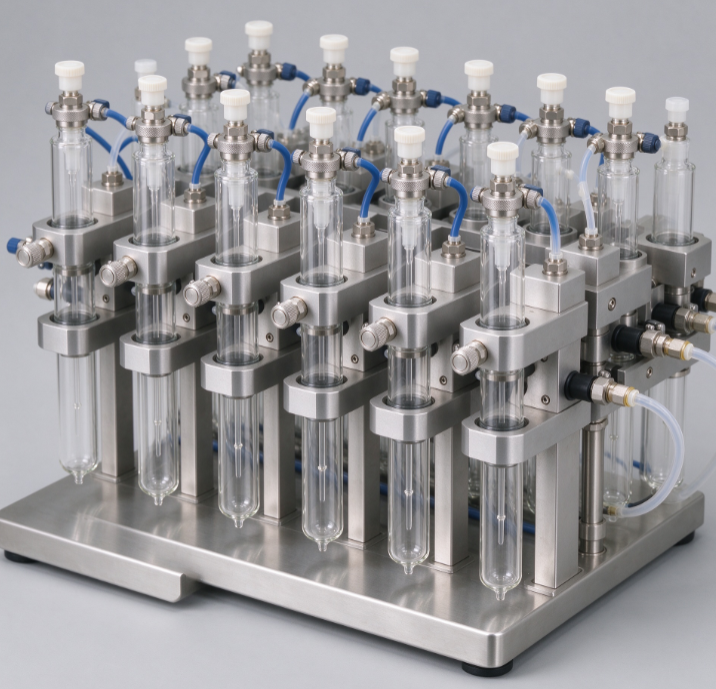
Multi position parallel reactor is a high-throughput chemical reaction equipment. It integrates multiple independent reaction chambers on one single platform.
Each reaction position can run separate experiments at the same time. It does not interfere with adjacent reaction units. This equipment changes the low-efficiency mode of traditional single-batch chemical testing.
It is widely used in chemical synthesis, pharmaceutical research and catalyst testing. Stable parallel operation and uniform parameter control make it standard lab equipment for high-throughput experimentation.
Core Technical Specifications
Standard multi position parallel reactor has fixed structural and operating parameters. These parameters decide its testing efficiency and result accuracy.
Reaction Position Configuration
Commercial mainstream models have 2 to 16 independent reaction positions. 6-position and 8-position parallel reactors are the most common in industrial labs.
Each position supports independent temperature and stirring control. It allows different reaction parameters in one test batch.
Temperature and Pressure Parameters
Normal working temperature range covers -20°C to 180°C. Custom low-temperature models can reach -78°C for special synthesis tests.
Standard working pressure stays below 10 bar. High-pressure enhanced versions can support up to 50 bar for catalytic reaction experiments.
Single Chamber Volume
Conventional chamber volume ranges from 5mL to 500mL. Small volume chambers fit sample screening. Large volume units support pilot-scale reaction verification.
Parallel Reactor vs Single-Position Reactor Performance Data
Multi position parallel reactor has obvious efficiency advantages over traditional single-position reactors. The table below shows verified lab test data for core performance indicators.
Performance Index | Multi Position Parallel Reactor | Single-Position Traditional Reactor |
Daily Test Batch Capacity | 24-48 batches | 6-8 batches |
Parameter Consistency Error | ≤1.2% | 3.5%-5.8% |
Manual Operation Time Consumption | 30% less | Benchmark (100%) |
Result Repeatability Rate | 98.7% | 91.2% |
Solvent Loss Rate | 1.8% per hour | 3.4% per hour |
Multi position parallel reactor greatly improves test throughput. It also reduces human error in repeated operations.
The unified platform structure keeps consistent environmental conditions for all reaction units. It makes experimental data more reliable and comparable.
Key Functional Advantages
High-Throughput Parallel Screening
Multiple reaction chambers run in parallel. Researchers can test different catalysts, temperatures and concentrations in one cycle.
It cuts total experiment cycle time. It speeds up formula optimization and product development progress.
Independent Parameter Control
Every position has independent stirring speed and temperature modules. No parameter interference between adjacent chambers.
Users can set different reaction conditions for each unit. It supports multi-group contrast experiments.
Low Solvent Loss and High Stability
Sealed chamber design reduces solvent volatilization. It maintains stable reaction concentration for a long time.
Uniform heating structure avoids local overheating. It prevents reaction failure and data deviation.
Common Multi Position Parallel Reactor Types
Glass Parallel Reactor System
Glass chamber material supports real-time reaction observation. It suits conventional organic synthesis and material testing.
It has overflow volume control structure. It ensures stable liquid level and fixed residence time.
High-Pressure Parallel Reactor
Stainless steel sealed structure adapts high-pressure catalytic reactions. It works for hydrogenation and oxidation experiments.
This type is widely used in new energy material and petrochemical research.
Low-Temperature Parallel Reaction Station
Equipped with professional refrigeration modules. It supports ultralow temperature synthesis reactions.
It meets special reaction demands of pharmaceutical intermediate synthesis.
Industrial Application Scenarios
Multi position parallel reactor covers chemical, pharmaceutical and new energy industries.
Pharmaceutical industry uses it for drug intermediate screening and process optimization. High-throughput testing shortens new drug development cycle.
Chemical research institutions apply it for catalyst performance testing. Parallel comparison quickly screens high-efficiency catalyst formulas.
New energy and material industries rely on it for battery material synthesis experiments. Stable parameters ensure batch test consistency.
Fine chemical factories use it for formula adjustment and small-batch trial production. It reduces raw material waste in mass production tests.
Industry FAQs
1. What is the most common configuration of multi position parallel reactor?
6-position and 8-position models are the most widely used. They balance test throughput and operation flexibility for most lab scenarios.
2. Can each reaction position work with different parameters at the same time?
Yes. Each chamber has independent temperature, stirring and timing control. Different reaction conditions can set separately without mutual interference.
3. What is the main advantage over single traditional reactors?
It improves testing efficiency 4-6 times. It provides more accurate contrast data. It also cuts manual operation cost and experimental error.
4. What industries need parallel reaction equipment the most?
Pharmaceutical synthesis, catalyst research, fine chemical development and new energy material testing are the core application fields.