Table of Contents
1. Introduction
2. Common Types of Hydrothermal Synthesis Reactor
3. Technical Parameter Comparison Data
4. Core Structural Components
5. Main Laboratory and Industrial Applications
6. Standard Operation and Safety Rules
7. Industry FAQ
8. Verified Data Sources
Introduction
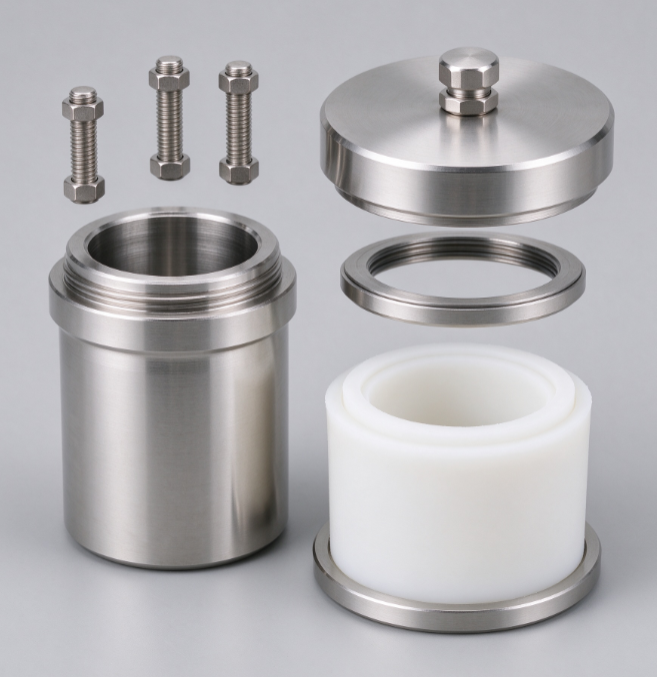
Hydrothermal synthesis reactor is a sealed pressure vessel. It creates high temperature and high pressure internal environment for chemical synthesis reactions.
It is widely used in material chemistry, environmental science and pharmaceutical research. It support crystal growth, nanoparticle preparation and hydrothermal reaction experiments.
PTFE lined hydrothermal autoclave is the most common lab model. Different liner materials and volume specs fit different reaction conditions.
Filling ratio, temperature limit and pressure resistance are the key indexes that decide reactor working performance.
Common Types of Hydrothermal Synthesis Reactor
PTFE Lined Hydrothermal Reactor
PTFE lined reactor is the basic type for general laboratory use. The inner PTFE liner is chemically inert.
It resist acid and alkali corrosion. It avoid sample contamination during hydrothermal synthesis processes.
This model work stable under medium temperature and pressure conditions. It suitable for most conventional material synthesis tests.
PPL High-Temperature Resistant Reactor
PPL lined hydrothermal synthesis reactor upgrade the temperature resistance limit. It can bear higher continuous heating temperature than PTFE liners.
It has better anti-aging performance. It fit long-cycle high-temperature hydrothermal experiments.
Many high-purity crystal synthesis experiments choose PPL lined reactors for stable output.
Stainless Steel Unlined Reactor
Unlined stainless steel reactors use 316 stainless steel body directly. It has stronger pressure bearing capacity.
It only apply to neutral and non-corrosive reaction materials. It cannot work with strong acid or strong alkali solutions.
Technical Parameter Comparison Data
Working parameters directly determine experiment accuracy and safety. The table below shows verified standard parameters of mainstream hydrothermal synthesis reactor models.
Reactor Type | Max Working Temp | Max Working Pressure | Standard Volume Range | Best Filling Ratio |
PTFE Lined Reactor | 220°C | 80 bar | 5ml – 1000ml | 60% – 70% |
PPL Lined Reactor | 260°C | 100 bar | 10ml – 500ml | 55% – 65% |
316 Stainless Steel Reactor | 300°C | 120 bar | 50ml – 2000ml | 50% – 60% |
Test data show filling ratio is a critical factor for synthesis results. Too high ratio cause excessive internal pressure. Too low ratio affect crystal morphology and particle size uniformity.
Research data prove adjusting filling ratio from 46% to 23% can obviously change nanoparticle size in hydrothermal synthesis reactions.
Core Structural Components
Pressure Vessel Body
The outer body adopt high-strength 304 or 316 stainless steel. It provide stable pressure bearing protection.
It resist deformation under long-term high-pressure working state. It guarantee experiment safety.
Inner Liner
PTFE and PPL inner liners isolate raw materials from metal body. It prevent chemical reaction and sample pollution.
Liner thickness and finish level affect reaction uniformity. Smooth inner surface reduce crystal adhesion.
Sealing Assembly
High-quality O-ring sealing structure lock internal pressure tightly. It avoid gas and liquid leakage during heating.
Complete sealing performance keep stable hydrothermal environment for synthesis reactions.
Main Laboratory and Industrial Applications
Hydrothermal synthesis reactor is core equipment for nanomaterial preparation. It produce uniform nano oxide and nano metal particles.
It support environmental water treatment material research. Many adsorbent and catalyst materials are made via hydrothermal reaction.
Geological simulation experiments also rely on this reactor. It simulate high temperature and pressure stratum environment for rock and mineral research.
New energy battery material synthesis use hydrothermal reactors in lab research and small batch production.
Standard Operation and Safety Rules
Do not exceed the rated temperature and pressure range. Overload operation cause safety risks and equipment damage.
Strictly follow standard filling ratio. Never fill the reactor with full liquid.
Cool the reactor completely before opening. High temperature residual pressure lead to liquid ejection accidents.
Clean the liner and sealing ring after each use. Residual reactants affect next experiment results.
Industry FAQ
Q1: What is the difference between PTFE and PPL lined hydrothermal synthesis reactor?
PPL liner has higher temperature resistance. It work stably under 260°C. PTFE liner max working temperature is 220°C. PPL also has better anti-aging performance for long-time experiments.
Q2: Why filling ratio is important for hydrothermal synthesis?
Filling ratio control internal vapor pressure and reaction equilibrium. Unreasonable ratio cause uneven particle size, crystal defect or pressure overload.
Q3: Can hydrothermal reactor work with strong corrosive materials?
Yes. PTFE and PPL lined models support strong acid and alkali reactions. Unlined stainless steel reactors cannot use corrosive raw materials.
Q4: How to extend hydrothermal reactor service life?
Strictly follow parameter limits, clean components after use, and replace aging sealing rings regularly. Standard operation reduce liner damage and pressure leakage issues.