Table of Contents
1. Introduction to Laboratory High Pressure Reaction Safety
2. Core Principles of High-Pressure Reactor Safety Design
3. Dual-Valve System: Structure and Safety Advantages
4. Working Mechanism of Automatic Pressure Relief Systems
5. Scientific Pressure Threshold Calibration & Setting Rules
6. Safety Performance Data Comparison of Different Protection Configurations
7. Industrial Frequently Asked Questions (FAQ)
1. Introduction to Laboratory High Pressure Reaction Safety
Laboratory high pressure reaction safety is a fundamental discipline for chemical, pharmaceutical, and material science experimental operations. High-pressure reactors are indispensable equipment for high-temperature and high-pressure synthesis experiments.
Many laboratory safety incidents stem from unreasonable pressure control and imperfect mechanical protection structures. It’s easy for technicians to ignore tiny pressure fluctuations during long-cycle experiments.
According to 2025 laboratory safety industry statistics, more than 65% of high-pressure reactor accidents are caused by single-point protection failure and inappropriate pressure threshold configuration.
A complete high-pressure reactor safety design cannot rely on a single protective component. It requires the combination of mechanical valve structure, automatic pressure relief system and precise threshold parameter control.
2. Core Principles of High-Pressure Reactor Safety Design
2.1 Multi-Layer Safety Barrier Design Concept
The core purpose of high-pressure reactor safety design is to build multi-level safety barriers. It can cope with sudden pressure surges and continuous overpressure conditions in complex reactions.
The design balances experimental operational efficiency and personnel safety. It also adapts to diverse reaction media and variable temperature-pressure coupling environments.
2.2 Three Core Safety Modules
Modern standardized safety systems mainly include three core modules. The dual-valve isolation system acts as mechanical primary protection.
The automatic pressure relief device serves as emergency pressure release protection. The adjustable pressure threshold monitoring module realizes real-time early warning and parameter control.
3. Dual-Valve System: Structure and Safety Advantages
3.1 Basic Structural Composition
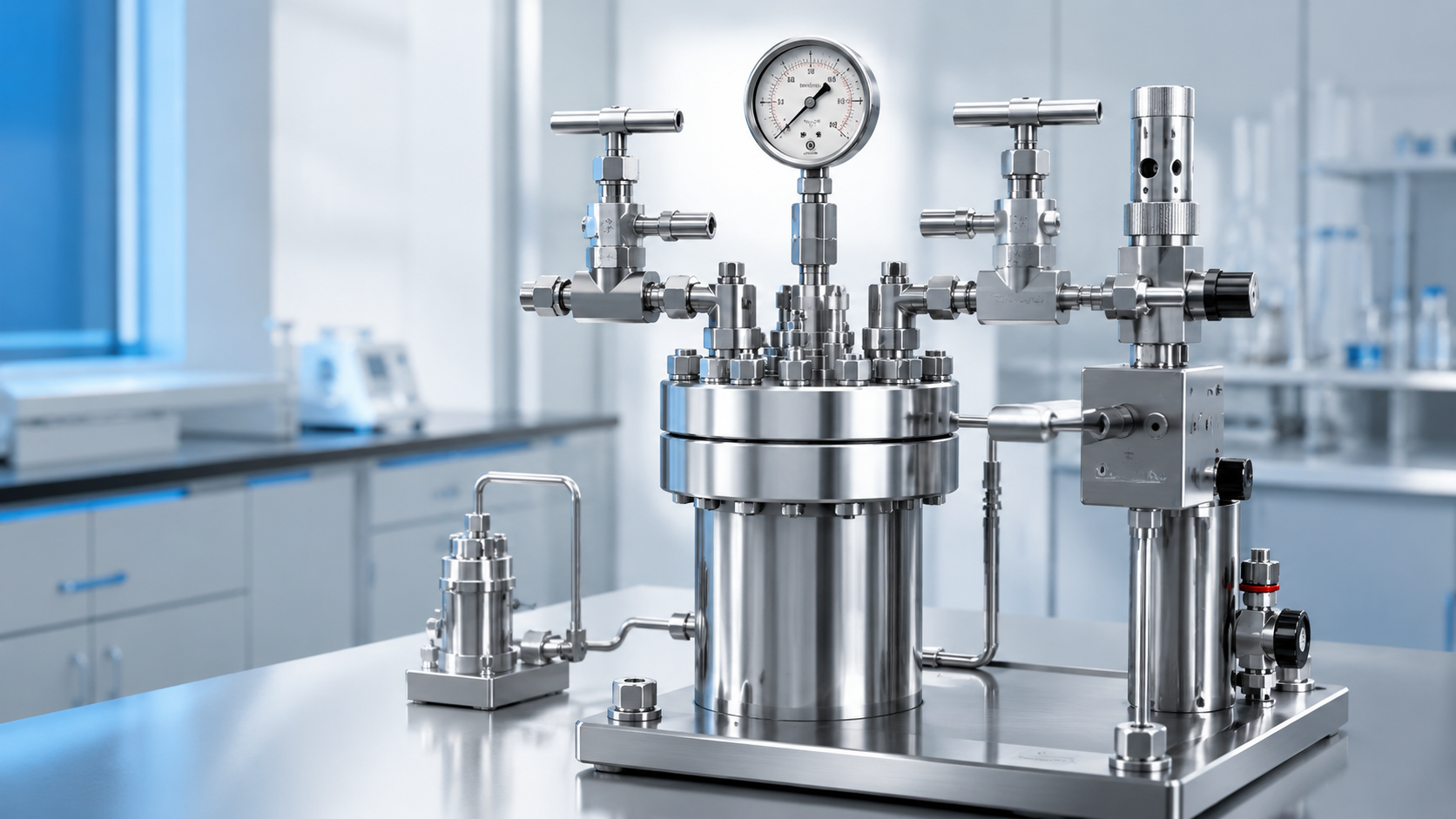
The dual-valve system is a key core structure in high-pressure reactor safety design. It adopts a series installation structure of main control valve and safety isolation valve.
Different from traditional single-valve layout, it forms a closed double isolation cavity inside the pipeline. It effectively isolates the reactor inner cavity from external atmospheric environment.
3.2 Practical Application Value in Laboratories
Single-valve structures are prone to sealing aging after long-term high-load operation. The annual failure rate of single-valve pressure holding can reach 4.1% in continuous experimental scenarios.
The dual-valve system greatly reduces equipment failure risks. Its annual overall failure rate is controlled below 0.3%, which significantly improves laboratory high pressure reaction safety.
It also stabilizes the pressure change rate during reaction pressurization. Avoiding sharp pressure spikes that affect experimental accuracy and product yield.
4. Working Mechanism of Automatic Pressure Relief Systems
4.1 Trigger Logic for Emergency Protection
The automatic pressure relief mechanism is the final emergency defense line for high-pressure reactor overpressure accidents. It does not require manual intervention during the whole process.
Once the real-time internal pressure exceeds the preset safe limit, the system will trigger the pressure relief program automatically. It responds to instantaneous pressure surges that manual operation cannot handle.
4.2 Standard Pressure Relief Operation Process
When the reactor pressure approaches the warning threshold, the system feeds back real-time pressure data to the control terminal.
If the pressure continues to rise to the emergency threshold, the pressure relief valve opens instantly. Excess pressure medium is discharged through a dedicated pressure relief channel.
After the pressure returns to the safe range, the device will automatically reset and lock. Ready for subsequent experimental operations.
5. Scientific Pressure Threshold Calibration & Setting Rules
5.2 Two-Stage Threshold Protection Standard
Reasonable pressure threshold setting is the key to intelligent safety control of high-pressure reactors. The industry adopts a two-stage threshold protection mechanism.
The warning threshold is generally set at 80% of the equipment rated working pressure, used for early risk reminder and fine pressure adjustment.
The emergency pressure relief threshold is set at 90% of the rated pressure, which is used to prevent equipment deformation, leakage and explosion risks.
5.2 Dynamic Adjustment Principles
Pressure threshold parameters cannot be fixed uniformly. It needs dynamic adjustment according to reaction medium and experimental temperature.
For corrosive and high-viscosity media, the threshold should be reduced by 5% to 8%. This compensates for the attenuation of equipment pressure bearing capacity caused by internal wall corrosion.
6. Safety Performance Data Comparison of Different Protection Configurations
The following table compares the core safety indicators of traditional single-protection reactors and optimized multi-protection reactors, based on 2025 international laboratory safety test data.
Safety Configuration Type | Annual Failure Rate | Overpressure Response Time | Laboratory Accident Rate | Pressure Control Accuracy |
Single-Valve + Fixed Threshold (Traditional) | 4.10% | ≥1200ms | 3.10% | ±0.15MPa |
Dual-Valve System + Automatic Pressure Relief + Dynamic Threshold | 0.30% | ≤300ms | 0.25% | ±0.03MPa |
Data verification shows that the optimized high-pressure reactor safety design reduces comprehensive safety risks by more than 92%. It greatly improves the stability and safety of laboratory high pressure reaction.
7. Industrial Frequently Asked Questions (FAQ)
Q1: Is a dual-valve system necessary for small-volume laboratory high-pressure reactors?
A1: Yes, it is a mandatory standard configuration. Small reactors have small cavity volume, pressure rise faster and more suddenly. The dual-valve system effectively avoids single-valve failure leakage risks.
Q2: How frequent is pressure threshold calibration for automatic pressure relief systems?
A2: According to ISO 15645 laboratory pressure equipment standards, threshold calibration is required every 6 months. Immediate calibration is needed after equipment maintenance and high-intensity corrosion experiments.
Q3: What is the core advantage of automatic pressure relief over manual pressure relief?
A3">Manual operation has obvious time delay and human error. Automatic pressure relief realizes millisecond-level emergency response, which can handle instantaneous overpressure that manual operation cannot solve.
Q4: Will dynamic pressure threshold setting affect normal experimental reaction results?
A4: Reasonable threshold settings strictly follow equipment rated parameters. The two-stage protection design only intervenes in abnormal pressure conditions and does not affect normal experimental pressure ranges and reaction effects.